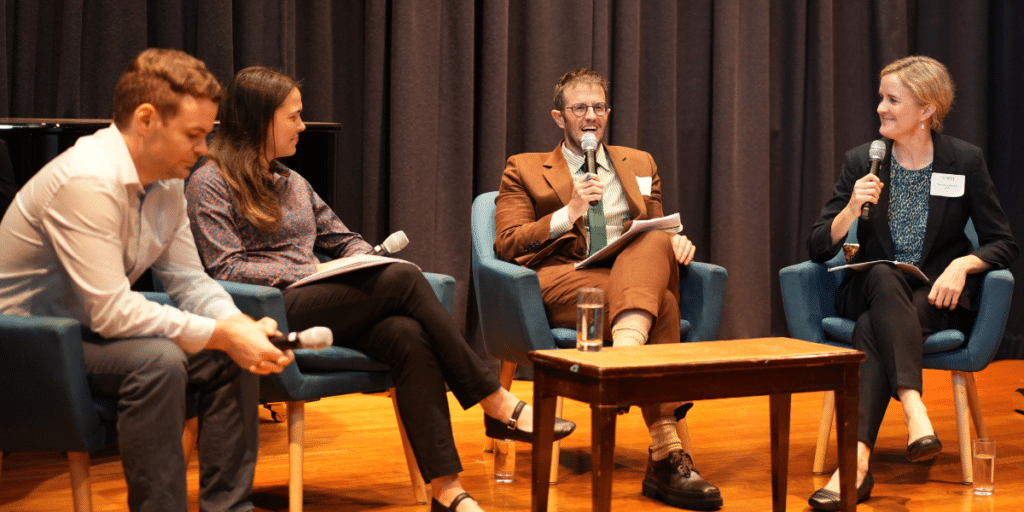
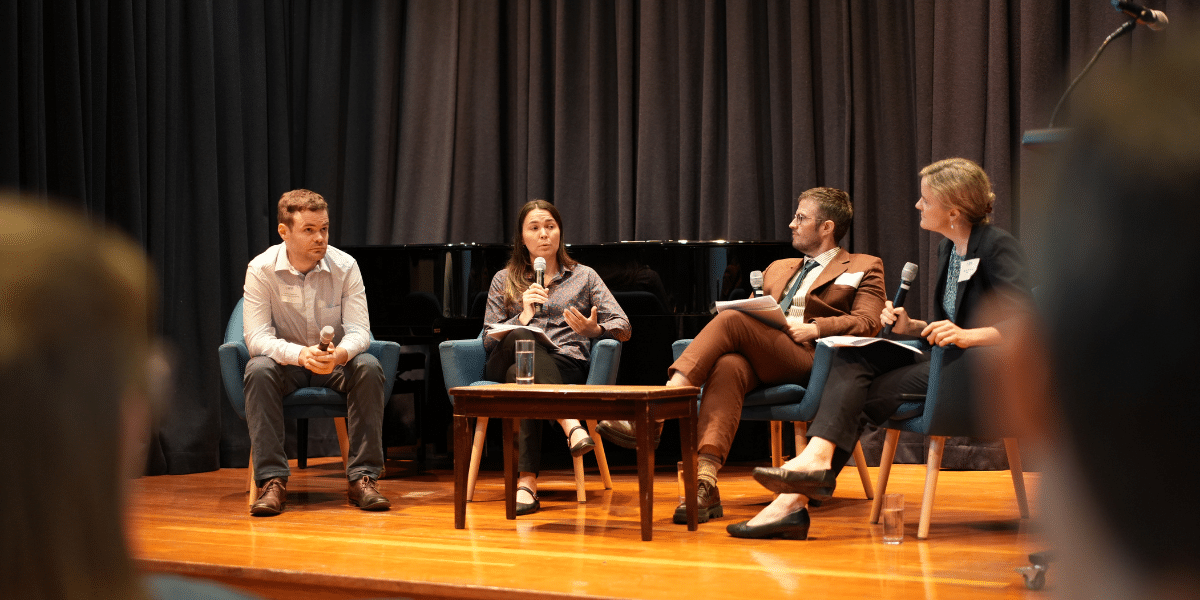
APPI’s latest Policy Talks event, held on 3 March at the Sydney Conservatorium of Music, brought together researchers, policymakers and practitioners to examine evidence-informed policy approaches to promote equity in school education.
Moderated by APPI’s Head of Social Policy, Marianna Brungs, the discussion focused on two issues relating to equity in school education: rising school exclusion and STEM education in non-metropolitan communities. Across both themes, a consistent message emerged: collaboration and participatory approaches, early intervention and stronger use of evidence – and availability of data – are essential to improving outcomes for all learners.
Rethinking school exclusion: prevention over punishment
Dr Archie Thomas (UTS) and Dr Samara Hand (UNSW) discussed their recent report examining escalating suspension rates and their long-term consequences. As Dr Thomas noted, “school exclusion leads to a range of really negative consequences… [with] a strong connection to involvement with the justice system.”
The researchers emphasised that while teachers are working in increasingly pressured environments, exclusion does not deliver behavioural or educational improvements. Dr Hand distilled the policy challenge clearly: “If we know that school exclusion doesn’t work… what are the alternatives to that?”
Their APPI-supported research highlights multiple contributing factors, such as limited access to counsellors and support staff, gaps in behaviour management training and systemic inequities that disproportionately affect First Nations students and students with disabilities. But the focus of the evening was forward-looking: what works.
International examples, particularly Scotland’s reduction in permanent exclusions, demonstrate what can be achieved when systems commit to inclusion and resource collaborative approaches. Central to these models is wraparound support, such as stronger alignment among schools, families, communities and frontline services, that intervenes earlier, before behaviour escalates.
The conversation reframed schools not simply as sites of discipline, but as powerful social institutions capable of transformation. When equipped with the right supports, they can keep young people connected to learning and opportunity.
A strengths-based approach to regional STEM
Dr James Deehan (Charles Sturt University) presented findings from extensive research into non-metropolitan STEM education in NSW, published by APPI in February 2026. Rather than focusing on deficits, the APPI-supported project adopted what he described as “a growth approach… looking for strengths and existing positive trends.”

The findings revealed encouraging signs: improvements in primary mathematics and science achievement gaps, increased vocational STEM pathways and strong baseline interest among young people. At the same time, challenges persist, particularly as students transition into secondary schooling.
For Dr Deehan, effective STEM education is less about disciplinary labels and more about authentic learning grounded in local context. It requires collaboration among schools, universities and industry, as well as evaluation to ensure that promising initiatives are sustained.
As he cautioned, many impressive programs exist, but too often lack an evidence base robust enough to protect them when conditions change.
Importantly, longitudinal data offers a hopeful insight: while socioeconomic background and geography strongly predict achievement levels, they explain only a very small proportion of students’ growth over time. What happens inside schools matters deeply, and growth is possible across contexts.

Shared lessons for policy
In closing reflections, APPI Executive Director Anthony Dursi drew together the themes running through the discussion: the importance of collaborative structures, the risk of losing effective local innovation in overly rigid systems and the long-term social costs of failing to invest in early interventions.
Above all, the evening reinforced a simple but powerful idea: education policy must keep the learner at its centre. “This is all about the young people, the students, and helping them to reach their full potential,” Dursi said.
APPI has also recently released a new report on participatory approaches to artificial intelligence (AI) in education, developed by researchers from the University of Sydney, the University of Technology Sydney and the University of Bergen. The report outlines a roadmap for how Australian schools can engage students, teachers and communities in shaping the responsible use of AI.
The Institute will also soon publish new research examining the interconnections between Australia’s teacher shortage and the housing crisis, exploring how housing affordability and availability are affecting the recruitment and retention of teachers across the country.
About the Series:
Policy Talks is a collaborative series hosted by APPI in partnership with the NSW Policy Community of Practice. Launched in 2024, the series aims to foster a cross-sector community of policy professionals committed to inclusive, evidence-based policymaking. Previous speakers have included The Hon. Anoulack Chanthivong MP, The Hon. Courtney Houssos MLC and Rebecca Pinkstone, CEO of Homes NSW.